 Rosella
Machine Intelligence & Data Mining
Rosella
Machine Intelligence & Data Mining
|
|||||||||
How to develop Customer Retention Strategies?Customer retention is very important because acquiring a new customer is far more expensive than keeping an existing one. This is even more true if the market operating is saturated or saturating as in mobile telecommunication industry. Retention is important to most businesses because the cost of acquiring new customers is much greater than the cost of keeping good relationship with current customers. Note that management of customer attrition is very important part of customer lifecycle management - CLM. Do you know why your customers are leaving and who they are?Can you develop effective retention strategies without knowing this vital information? Will it be possible to do so? The single most important thing in customer retention is to understand your customers well enough: customers' expectations, satisfaction, demographic & geographic & psychographic customer tendencies, etc. If you understand more about customers and know more about which customer groups are defecting to rival providers, more effective retention strategies can be developed. This is the key to the successful retention marketing! How customer surveys can be used to predict customer churns?Customer surveys are very important means for identifying potential problems in your services. Most common reasons for customer defection include inadequate service quality and high cost. Ask customers to rate your services along with their demographic and psychographic profiles. When it is matched (or combined) with customer churn status, it can reveal surprising information! Analyzing surveys can reveal customer groups who are not happy with your services. Actions can be taken to prevent customer defections. Customer churn analysis and detection methodsFor obvious reasons, the most important customer retention strategy is to identify customers who are likely to churn (potentially to rival providers). Once they are identified, customer retention programs can be developed and actions can be taken. The following analytic techniques (customer churn analysis) can be used to identify customer groups having high defection risk;
Customer churn trend analysisCustomer churn trends can be analyzed with time-series analytic tools described in sales trend analysis. It can identify trends of customer segments in various ways: geographic, demographic, psychographic factors, and so on. It uses time-series predictive modeling to identify trends in sales amounts, customer numbers, etc. Customer churn profilingProfiling churns can reveal customer segments and the reasons why customers are leaving your service. Customer information, when all combined, can be very large. It may consist of dozens of fields. Analyzing data with many variables with conventional tools is a challenge. Using CMSR hotspot analysis tools, profiles of high-risk groups can be accurately identified instantaneously. Customer Churn Predictive Modeling and Churn ScoringCustomer churn scoring is a very appealing approach provided that accurate scores can be computed. Generally speaking, customer defection is relatively a low ratio event. Developing predictive models on low event data is extremely difficult and therefore models tend to be inherently un-reliable. Fortunately, neural network provides a way to identify customer groups that have shown to have high churn ratios in high accuracy. The following figure shows an example of customer churn scoring produced by a customer churn predictive model. 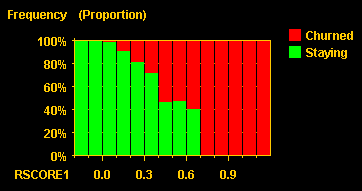
Reds are customers who have churned. They are concentrated at high churn score ranges. Customers scored high but not churned have high probability of churning in the near future. In the histograms, they are represented in green parts. Preventive actions should be taken to those current customers with high scores. YouTube Tutorial Videos: Churn Risk Neural Network ModelingWatch this credit risk modeling video YouTube video on Neural network modeling for Risk Management. The same method is used to predict customer churn risk. Just replace credit data with your customer churn data. For information about predictive software used here, please read Data Mining Software. Software download is available from the page. For information about predictive modeling, please read Predictive Modeling Software. |

|
||||||||