Customer Segmentation
Why customer segmentation? People with similar attributes tend to display
similar patterns in various ways.
This fact is particularly important in customer relationship management, marketing,
and risk management. For example, people with certain life-styles tend to buy
certain-types of products. Promoting products particularly targeted towards
the demographic group can lead to successful marketing.
In credit and insurance industry, good customer segmentation can lead to minimum
exposure to risk involved in credits and insurances.
Similarly, in catalog sales, customers can be selectively targeted
to reduce marketing cost. Customer segmentation can be used in
various ways.
Note that customer segmentation is a very important tool
for customer lifecycle management - CLM.
Technically speaking, customer segmentation is a process that divides
customers into smaller groups called segments.
Segments are to be homogeneous within and desirably heterogeneous in between.
In another words, customers of the same segments possess the same or similar
set of attributes. But customers of different segments have differing
sets of attributes.
Segmentation process can be very complicated. Therefore, it's best to use advanced
analytic tools.
What information is used in customer segmentation?
Segmentation is normally performed along with the following demographic, geographic,
psychographic, and behavioral variables;
- Demographic segmentation variables describe characteristics of customers and
include age, gender, race, education, occupation, income, religion,
marital status, family size, children, home ownership, socioeconomic status, and so on.
Note that demographic segmentation normally refers to segmentation with these demographic
variables.
- Geographic variables include various classification of geographic
areas, for example, zip code, state, country, region, climate, population,
and other
geographical census data. Note that this information can come from
national census data. For more, see geographic segmentation.
- Psychographic segmentation variables describe life style, personality, values, attitudes,
and so on.
Note that psychographic segmentation normally refers to segmentation with these psychographic
variables.
- Behavioral segmentation variables include product usage rate and end, brand royalty,
benefit sought, decision making units, ready-to-buy stage, and so on.
- Past business history, Customers' past business track records
can be extremely useful for segmentation. This may include total amounts purchased,
purchasing frequency, (credit) default records, (insurance) claims, responsiveness
for marketing campaigns, and so on.
|
What is your motivation for Customer Segmentation?
This is very important since there are many ways you can segment customers.
Without clearly defined motivation, no clear segmentation objectives.
Segmentation is meaningless. You need to have clearly defined motivation
and objectives to achieve. For example, to optimize profits for campaign marketing,
or to monitor customer or market trends, or to manage customer loyalty programs,
or to use for customer lifecycle management,
and so on.
Depending on your motivation, different segmentation techniques are employed.
Note that CMSR Data Mining Software provides several
segmentation and segment monitoring tools such as decision tree, neural clustering, etc.
Customer Segmentation for Trend Analysis and Forecasting
Timely identification of newly emerging trends is very important
to businesses. For example, sales patterns of various customer segments
indicate market trends. Upward and downward trends in sales signify
new market trends. The same can be applied to loans, mortgages, credits,
and so on.
Trend analysis and forecasting over well-designed customer segmentation
is a powerful tool for monitoring and detecting newly emerging trends.
For more, please read Trend Analysis and
Forecasting.
Customer Segmentation using Neural Clustering (SOM)
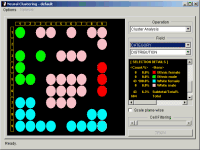
Neural clustering segments customers MxN cells in such a way that customers with similar
attributes are clustered together in a cell or nearby cells. In the left figure, colored circles are pie charts representing distribution
for combination of gender and race. Notice that all cells contain objects
of the same single type. Furthermore, nearby cells of the same type objects
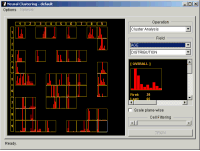
are clustered together. An example of perfect clustering! The middle figure
shows histograms for a numerical variable. You will notice that nearby
cells have similar distributions.
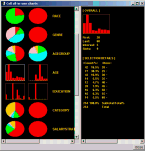
The right is all-in-one distribution charts for a specific cell segment.
Customer Prioritizing and Segmentation (PDF)
People with similar attributes tend to exhibit similar behaviours in various ways. This fact is particularly useful in customer relationship management, marketing, and risk management. It can be used in prioritizing customer services and risk management. For example, customers with higher risk of churning can be identified using predictive analytics and prevention measures can be executed based on customer priority.
In this paper, the following predictive methods for customer prioritization are described;
- Customer Hotspot-Segment Profiling
- Customer Scoring (Neural Network)
- Supervised Customer Segmentation (Decision Tree)
- Unsupervised Customer Segmentation (Neural Clustering)
The first method is to identify profiles of customer segments with highest/lowest probability. It will provide quick information which customer segments are in need for priority actions.
The second method is to compute customer scores using neural network predictive modeling. Customer scores then are used to rank and prioritize customers.
The last two methods are based on segmentation. The third uses decision tree. Using supervised learning techniques, segmentation tree is developed. Segments are then ordered based on higher probability.
The fourth is based on unsupervised learning techniques. It uses neural clustering, aka, Self-Organizing Maps (SOM). It partitions and clusters customers based on similarity of attribute values. Note that this method does not use target variables in computing similarities. Segmentation may not produce useful results
For step-by-step guides for these methods, please read
Customer Prioritizing and Segmentation (PDF). Note that this is based on CMSR Data Miner. You need CMSR Data Miner for this.
|
|
 Rosella
Machine Intelligence & Data Mining
Rosella
Machine Intelligence & Data Mining
