Market Segmentation for Segmentation Marketing

Why market segmentation? People with similar attributes tend to display similar propensities in their purchasing behaviors. This is often accompanied by social fads and trends that may be specific to certain market segments. Market segmentation is a process that segments a market into smaller sub-markets, called segments. Segments are to be homogeneous or have similar attributes. Purchasing patterns and trends can appear prominently in certain segments. Good market segmentation is to create segments where prominent patterns can emerge. Market segmentation may be used to analyze the followings;

  • Market responsiveness analysis: This is very useful in direct marketing since market responsiveness of product offerings can be readily available.
  • Market trend analysis: Analyzing segment-by-segment changes of sales revenues can reveal market trends. Trending information is vital in preparing for ever-changing markets.

Handbook of Database Marketing
If you are interested in methods described in this page, please register from here. We will send you free "Handbook of Database Marketing", currently in writing, as soon as it becomes available. It describes the procedures described here such as customer profiling, customer segmentation, targeted marketing customer selection, RFM segmentation marketing, cross-sell marketing, customer churn detection modeling, gains and profit analysis, data preparation, and more. If you are interested, please register from here.

Market segmentation for Market trend analysis

Market segmentation creates segments with the same or similar attributes. It normally uses the following attributes to generate market segments. One or more of the attributes may be used to define market segments.

  • Geographical regions: regions, countries, states, zip-codes, counties, etc.
  • Demographics: gender, age, income, education, etc.
  • Psychographics: life style classification.
  • Sales channels, branches, and departments.
  • Sales representatives.
  • Product and service types (or product categories).
  • Products.
  • Offer types.

Segmentation provides opportunities for trend analysis. Trends and patterns embedded in changes of sales revenues can be useful indicators for market shifts. Trend analysis may answer the following types of segment trend information;

  • What are projected sales revenues for the next three months (or quarters)?
  • Which segments are having highest growth in dollar terms?
  • which segments are having highest revenue decline in dollar terms?
  • Which segments are having highest growth rates in percentage terms?
  • Which segments are having highest revenue decline rates in percentage terms?
  • How solid the growth or decline trend is?
  • Which segments are showing exponential growth (or decline)?

Market trend analytics

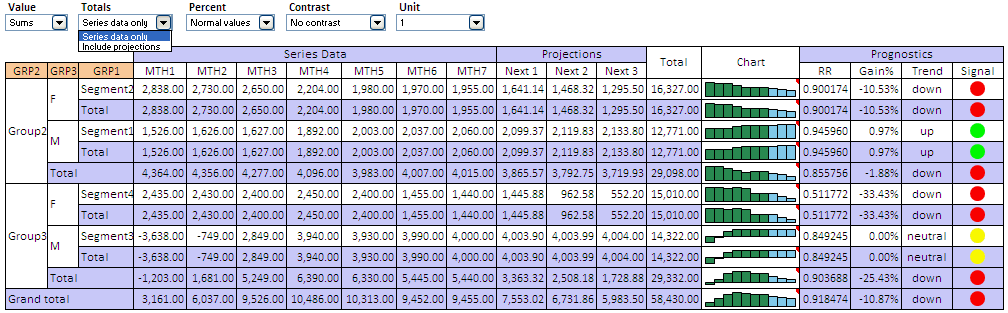
StarProbe OLAP Server provides a robust platform for building sales data warehouses, containing sector-by-sector sales histories. Sales revenue data warehouse can be analyzed with easy-to-use browse tools which can provide various trend analysis information. For example, (short-term) sales forecasting, growth rates, growth percentages, trend significance, trending types, and so on. The following figure shows an example of StarProbe OLAP for sales trend analysis. For more, also read StarProbe OLAP Server.

market segmentation and trend analysis.

Market segmentation for Direct marketing and Database marketing

Generally, direct marketing is based on database marketing where database is used as the medium to record customer information. Database often contain variety of customer information that can be used in designing market segmentation, more specifically, predictive segmentation. Predictive market segmentation is described in detail in Customer Segmentation.